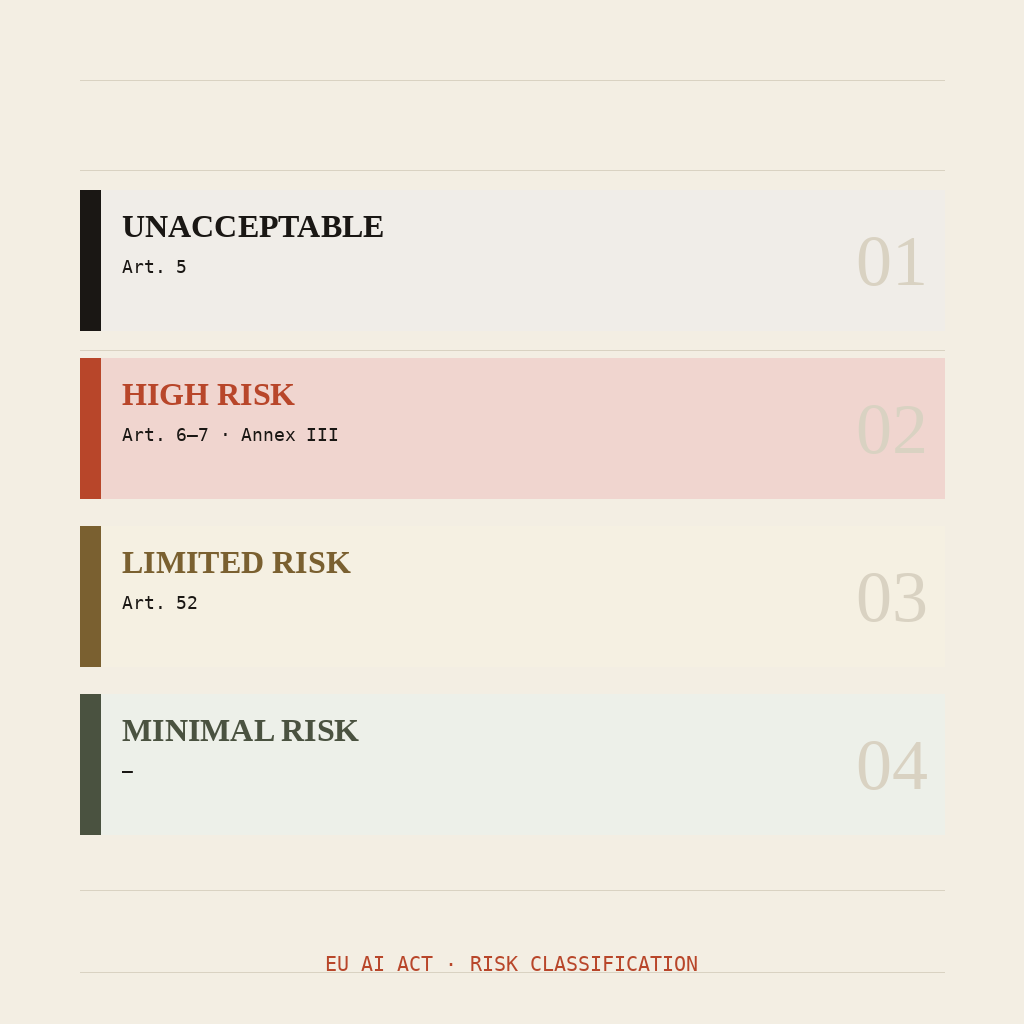

2 August 2026 is the date that matters for most organisations building or deploying AI systems in the EU. That is when the conformity requirements for high-risk AI systems under Article 6(2) — the Annex III domains — become fully applicable.
It is not a grace period. It is the date by which:
- The Technical File must be complete and up to date
- The quality management system covering Articles 9–15 must be in operation
- The system must be registered in the EU AI Act database
- The declaration of conformity must be signed
- The CE marking must be affixed
For systems that were already on the market before August 2026, transitional arrangements apply under Article 111 — but only if no significant modification has been made. A significant modification resets the clock and requires full conformity from the modification date.
Why the preparation window is shorter than it looks
August 2026 is three months away as this note is published. That sounds like adequate time. It is not, for two reasons.
First, assembling a Technical File from an existing system takes eight to sixteen weeks — and that assumes the documentation effort begins immediately, with people available to work on it. Most organisations do not have that capacity sitting idle.
Second, the risk management process under Article 9 must be documented prospectively, not retrospectively. A risk register assembled in the week before the deadline, with no evidence of the testing and evaluation it claims to describe, will not satisfy a market surveillance authority.
What to prioritise now
If your system falls within Annex III and you have not begun conformity preparation, the minimum viable starting point is a classification decision (is this system actually high-risk?) followed by a documentation audit (what do we have, and what is missing?). Those two steps take days, not weeks, and they determine whether the August deadline is achievable or whether you are deploying a non-conformant system.
The full conformity framework is detailed in Article 9 and Annex IV. The practical question most organisations need to answer first is simpler: have you decided whether this system is high-risk, and have you written that decision down?
Reference: Regulation (EU) 2024/1689, Articles 6, 9, 11, 47, 48, 111, Annex III, Annex IV.