
BelkX Insights exists because the conversation about AI and regulation is dominated by two kinds of content: breathless announcements about the technology, and impenetrable summaries of the law. Neither is particularly useful to the people who actually have to make decisions.
We write for a narrower audience. The head of legal at an industrial firm trying to understand whether her company's quality-control vision system is high-risk under Article 6. The CTO building an agentic workflow who needs to know what human-in-the-loop actually means in practice. The compliance officer mapping ISO 42001 onto a system that was never designed with governance in mind.
For those readers, we try to be precise where others are vague, and brief where others are exhaustive.
Two formats
Notes are short. Two to four minutes. A regulatory development, a deadline reminder, a clarification on a point of law that keeps coming up in our client work. Published when something is worth saying, not to a schedule.
Briefings are longer. Fifteen to thirty minutes. A practitioner's guide to a specific obligation — what it requires, what evidence satisfies it, what we have seen go wrong. Published monthly, on topics where depth is the only honest approach.
Both formats cite the primary sources. We reference articles, annexes, and recitals directly. We do not summarise without attribution, and we do not make confident claims about regulatory interpretation without flagging where reasonable people disagree.
What we cover
Our coverage follows the three pillars of the practice.
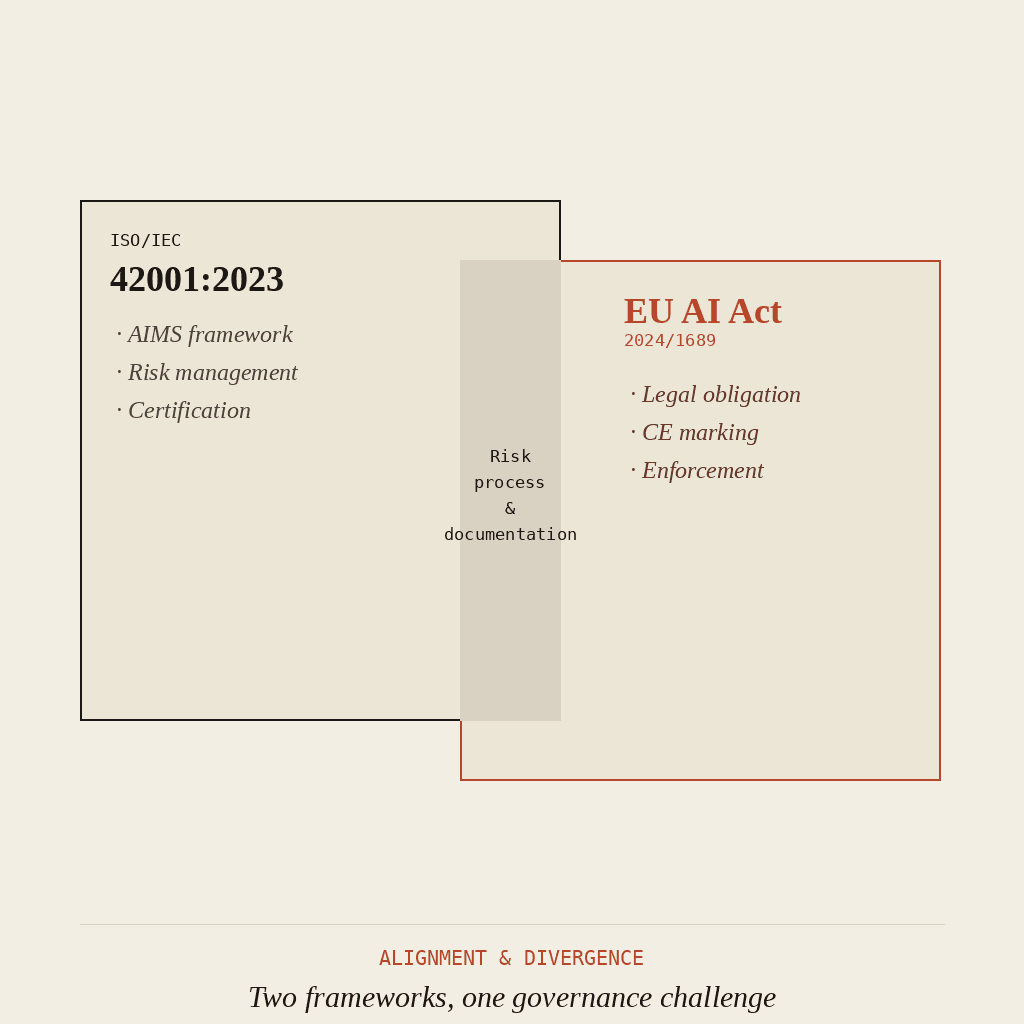
Advisory and governance — The EU AI Act, ISO/IEC 42001:2023, and the governance frameworks organisations need to manage AI responsibly. This includes risk classification, conformity assessment, the Technical File, post-market monitoring, and the emerging GPAI code of practice.
Implementation — The engineering and architectural decisions that determine whether an AI system is auditable, observable, and safe. Agentic AI design, human-in-the-loop controls, RAG architecture, and edge deployment.
The Academy — AI literacy as a regulatory obligation (Article 4 of the EU AI Act makes this explicit), and the practical questions organisations face when building internal competence at pace.
What we do not cover
We do not review products, benchmark models, or comment on the latest foundation model release unless it has a direct bearing on regulatory compliance or enterprise governance. There is no shortage of that content elsewhere.
We do not offer legal advice. Where we discuss regulatory obligations, we are sharing our reading of the text and our experience applying it — not a legal opinion. For decisions with material consequences, organisations should take their own legal counsel.
The MENA and Europe angle
BelkX operates from Casablanca and Rabat, advising organisations across MENA and Europe. That position gives us a particular vantage point on the EU AI Act's extraterritorial reach — which extends to any AI system whose output is used in the EU, regardless of where it is developed — and on the practical differences between regulatory environments that are often treated as uniform.
We will write about both. The EU AI Act is not only a European story.
The archive begins here. The first Briefing, on EU AI Act risk classification, is a reasonable place to start.